
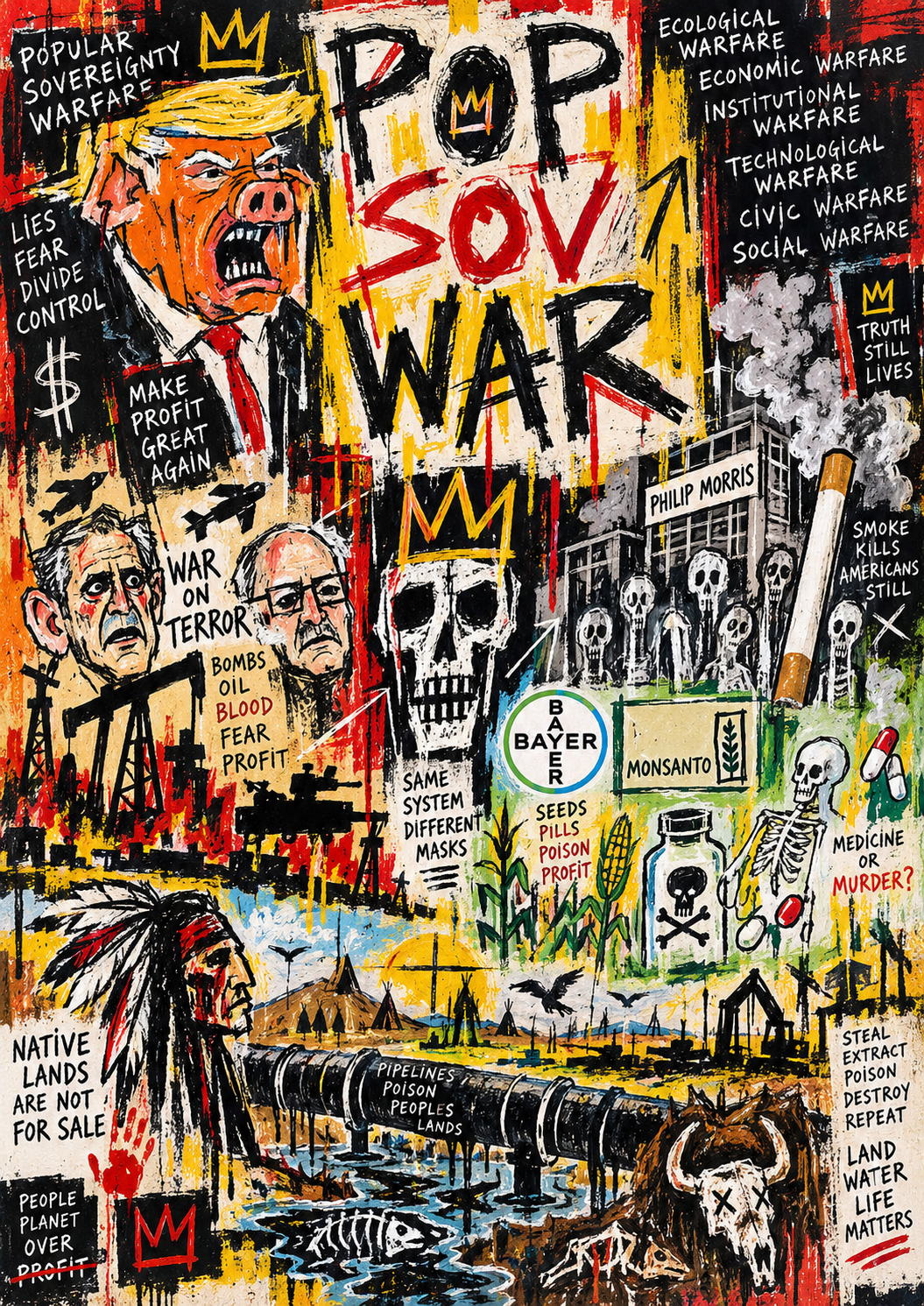
Pop Sov Warfare
- By
- M.J. Zilla
- Format
- Paperback / Digital
- Publication
- Forthcoming
- Published by
- PopSov
A book about power, warfare, and popular sovereignty
It can move through institutions, law, money, expertise, administration, and the structures that make public decisions binding. In Pop Sov Warfare, M.J. Zilla examines how public power can become captured, distorted, insulated, or converted away from popular answerability, and how those political changes can interact with other domains of collective life.
A project of PopSov.org
M.J. Zilla examines power across systems rather than treating political, economic, epistemic, social, technological, civic, and ecological conditions as isolated from one another. The book enters that larger analysis through Pop Sov Warfare, one domain within the Septology.
No system has to act alone
for its effects to compound.
Power can convert.
Conditions can reinforce.
Capacity can narrow.
The Septology
The Septology identifies seven selected core Warfare domains through which oppressive power can attack, degrade, capture, extract from, constrain, or disable substrates of collective life. Ecological Warfare is numbered 00 because it functions as the material life-support substrate. Pop Sov Warfare is 02, and it is the domain this book enters through.
Seven warfare domains.
02Pop Sov Warfare
Pop Sov Warfare examines warfare on the popular sovereign’s effective capacity to constitute and authorize public power, participate in collective self-determination, and keep that power answerable to the people.
The book examines capture, representation distortion, institutional insulation, moneyed influence where evidenced, public-authority conversion, and other mechanisms through which political authorship and public answerability can be degraded.
The control cycle
The Control Cycle asks how power or capacity lost in one domain can become usable leverage in another, and how those changes can feed back over time. These relationships are evidence-bounded rather than universal: a case may activate one domain, several domains in another order, or no supported cross-domain cycle at all.
The wheel preserves the Septology’s spatial relationships. It does not prescribe a universal chronology.
Pop Sov Warfare
The book distinguishes documented fact, causal inference, competing explanation, and unresolved uncertainty rather than forcing every case into the framework.
Follow the moneyWho decides?Who benefits?The Scorecard
A living tally of litigation outcomes.
This scorecard summarizes major legal challenges to executive action. Green marks cases the people won, red where they lost, and yellow where litigation continues. Counts are summaries, not verdicts — each case remains drillable to its procedural status and source.
All topics included · 952 cases in comparison. Binary win share = won ÷ (won + lost).
Recently updated
An examination of public power, political authorship, and popular answerability.
Pop Sov Warfare focuses on one Warfare domain inside the broader Septology. It examines how public authority can be captured, distorted, insulated, or converted away from popular answerability while tracing supported relationships with other domains where the evidence warrants them.
Who is public power actually answerable to?
From analysis to response
Resistance limits forward harm. Countering reduces or reclaims leverage. Reconstruction changes the conditions that allow the mechanism to reproduce.
Impede, slow, block, refuse, or prevent an active harmful mechanism.
Deploy counter-capacity to reduce, offset, push back, bypass, or reclaim leverage created by the mechanism.
Change the structural conditions that make the mechanism effective or reproducible.
Popular sovereignty means preserving the capacity of people to shape the systems that shape their lives.
Popular sovereignty begins with capacity
Read the book. Follow the evidence. Continue into the community through NME.
Read · Investigate · Organize · Build